
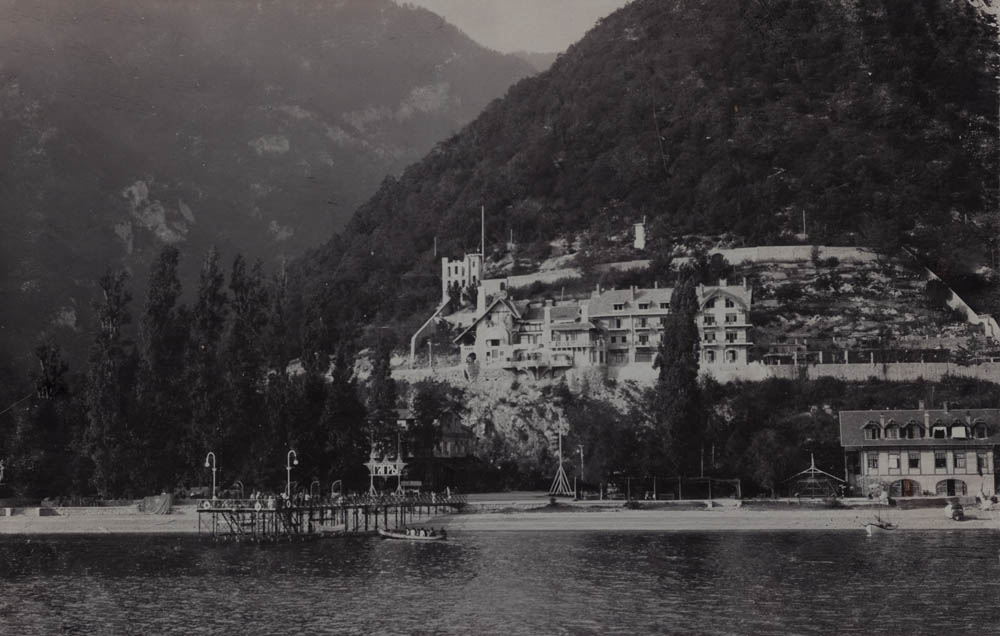
Settlement in the Gagra area dates back more than two millennia.
Founded as the Greek colony of Triglite in the I century BC, it later came under the influence of the Hellenistic Kingdom of Pontus before being captured by Rome in 65 AD and renamed Nitika.
Following the division of the Roman Empire in 395 AD, the town became part of the Byzantine Empire.
By the Middle Ages, Gagra was known to Genoese merchants, and its harbour may have served their trade.
The name “Gagra” first appears on a 1308 map by the Italian cartographer Pietro Visconti (also recorded as Vesconte), preserved in Venice’s Library of Saint Mark.
The expanding Ottoman Empire captured Gagra in the XVI century, after which the expulsion of Western merchants contributed to a long period of decline.
During the XIX century, the town was contested by the Ottoman and Russian empires and deteriorated further; an 1866 census recorded just 616 inhabitants.
Gagra was ultimately destroyed during the Russo-Turkish War of 1877–1878.
Gagra’s revival began in 1901, when Prince Alexander of Oldenburg, a relative of the Romanovs, recognised the potential of its subtropical climate and secured imperial support to develop an upscale resort modelled on the Mediterranean Riviera—earning it the nickname “Russian Nice”.
Development included drainage and malaria control, a pier, telegraph and electricity networks, water infrastructure, a subtropical park, hotels, and other amenities.
The resort officially opened on 9 January 1903 at the Gagripsh restaurant.
Following the revolutions and Civil War, the Bolsheviks nationalised the resort, and Lenin designated it a worker’s health resort.
During the Soviet era, Gagra became a major Black Sea sanatorium and holiday destination, and during World War II it served as a rehabilitation centre for wounded soldiers.
Postwar reconstruction brought further development and prominent architectural additions, such as the Gagra
Colonnade (unveiled on Janury 23, 1956).