
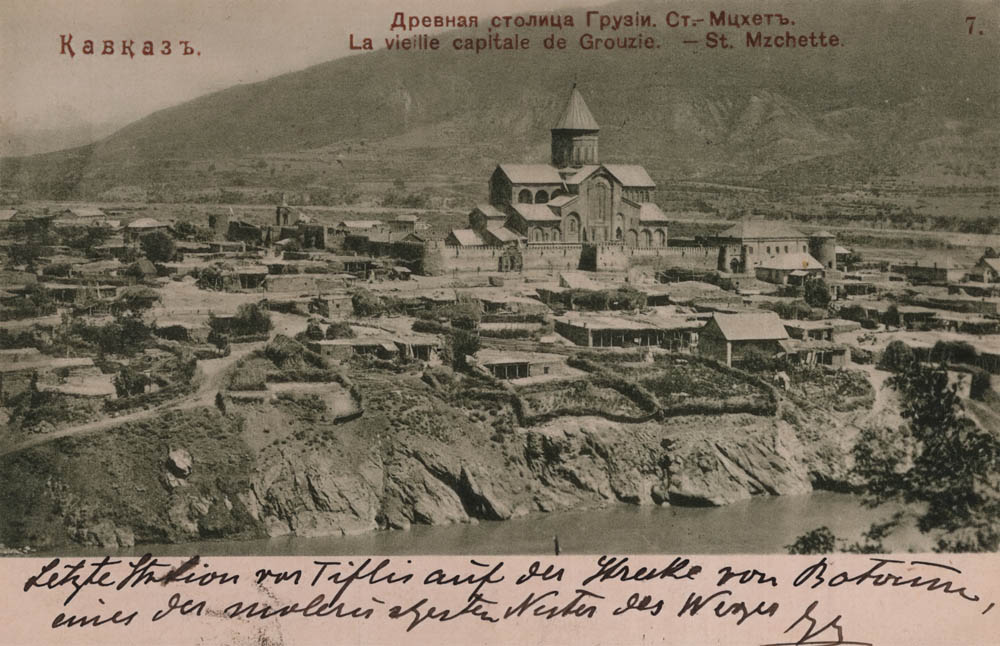
The history of Mtskheta spans more than 2,600 years.
It clearly existed in antiquity, although at that time it was more of a settlement than a city.
It is approved by the archaeologists that Mtskheta as a city took shape in the VI-V centuries BC.
Today, the history of this city is known to us only in a very fragmentary way – the main events in Mtskheta’s history occurred mostly in the beginning of first millennium and the V-VI centuries AD.
In Spring 65 BC, the Roman general Pompey arrived here with his army.
He occupied Mtskheta and Armazi, and somewhere near the Aragvi River defeated the army of the Iberian king, after which he concluded a peace treaty with Iberia.
Pompey is known also by building a bridge across the Kura river.
This bridge stood for a very long time, was rebuilt several times and survived until the XX century.
In the IV century, between 320 and 324, Saint Nino came to Mtskheta from the west, from Urbnisi, and it was here that all the events connected with the Christianisation of Georgia took place.
In 447, Vakhtang I Gorgasali became king of Iberia, and his main palace was located in Mtskheta.
His first major deed is considered to be a campaign against the Huns, and he gathered his army for this campaign in the fields north of the city, on the banks of the Aragvi.
Gorgasali is known for transforming the Mtskheta archbishopric into a Catholicosate and for bringing order to the system of bishoprics.
In particular, he established a separate Mtskheta bishopric.
This reform likely included the construction of large stone churches.
Specifically in Mtskheta, Gorgasali rebuilt the Svetitskhoveli Cathedral into a large stone basilica, fragments of which can still be seen there today.