
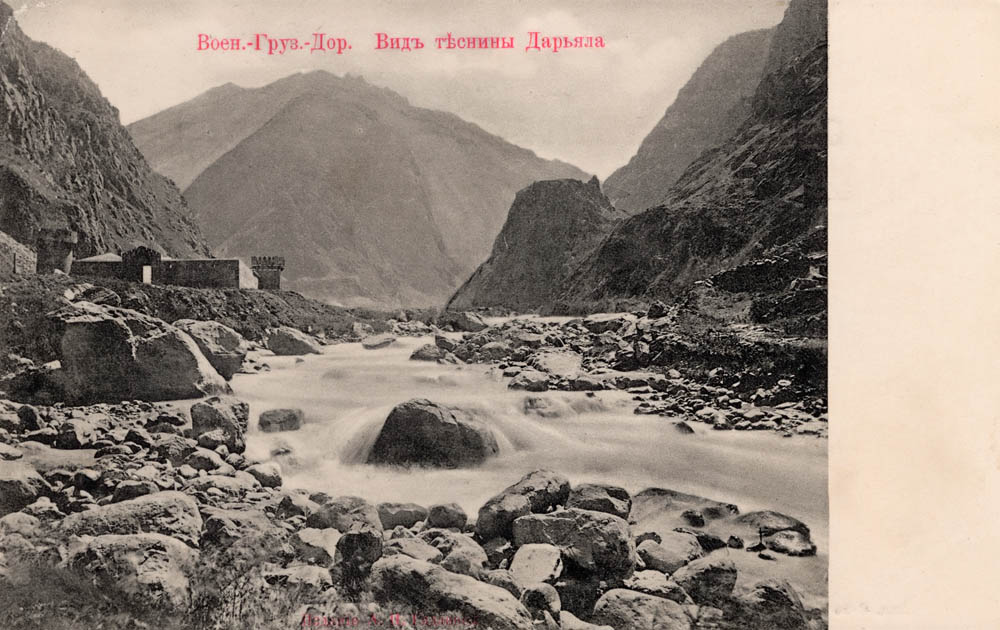
The Daryal Gorge is one of the most magnificent and strategically significant places in the Caucasus.
Situated on the border between Russia and Georgia, this narrow, thirteen kilometre long defile, carved by the turbulent Terek River, has since ancient times been regarded as the key to the region.
In antiquity, the gorge was known as the Gates of the Caucasus or the Alan Gates, as it provided one of the few accessible passages across the Greater Caucasus Range (the only other major route lay near Derbent on the Caspian coast).
Such a vulnerable frontier required strong defences: the first fortifications here were established by the Romans as early as the II century BC.
In the V century AD, the Georgian Kingdom of Iberia (Kartli), caught between the competing interests of the Byzantine Empire and Sasanian Iran, concentrated its efforts on strengthening its northern frontier.
According to Georgian chronicles, King Vakhtang I Gorgasali erected formidable fortifications in the pass. At that time, control of the Daryal Pass ensured dominance over the entire region, making it a prize fiercely contested by the leading powers of the ancient world.
A new chapter in the history of the gorge began at the end of the XVIII century, when the legendary Georgian Military Road was laid through it, with construction completed by the mid-XIX century.
The project advanced only with immense difficulty: workers faced the constant threat of devastating landslides and raids by highland tribes.
Nevertheless, the route was completed, transforming the Daryal Gorge into one of the most important transportation and military arteries of the Caucasus.
The gorge’s austere, untamed beauty has inspired great artists and writers for centuries.
Alexander Pushkin immortalised these landscapes in Journey to Arzrum (1835), while Mikhail Lermontov celebrated them in his narrative poems The Demon (1839) and Tamara (1841).
The majestic cliffs of the gorge were also captured on canvas by Ivan Aivazovskiy (1862), Arkhip Kuindzhi (1895), and many other masters of Russian painting.