
The Duchy of Aragvi was a feudal state located in the upper reaches of the Aragvi River.
The state existed from the XIV to the XVIII centuries.
The domains of the eristavs (dukes) of Aragvi stretched from the foothils of the Main Caucasian mountain range in the north to the left bank of the Kura River in the south.
From west to east, the territory stretched from the Liakhvi River (in today’s Shida Kartli province) to the Gremi mountain in the east (located in today’s Kakheti province).
According to a 1770 census, the duchy had a population of 3,300 households.
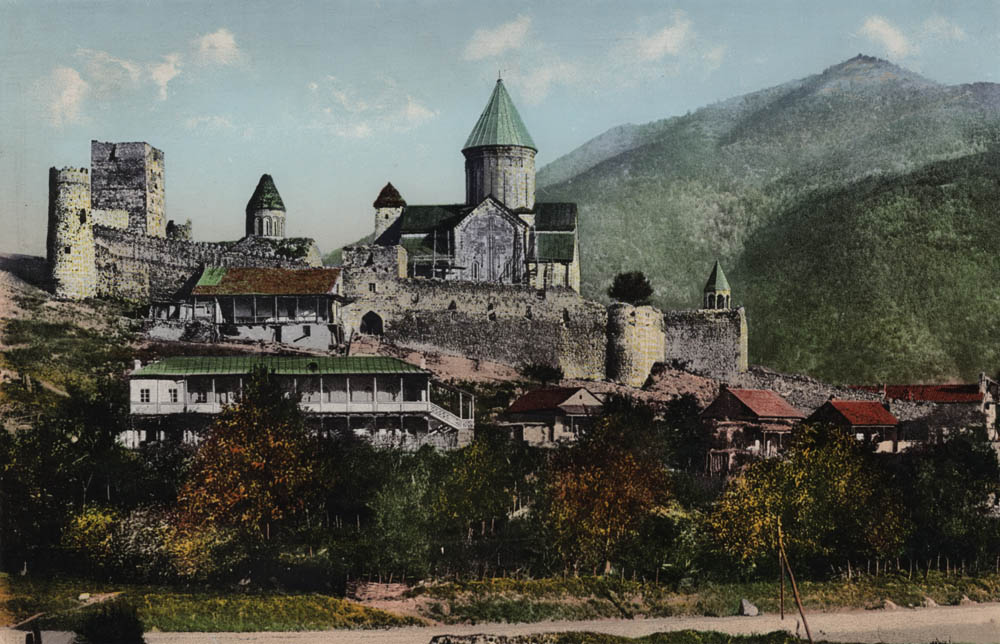
The royal residence of the Aragvian dukes was located in Ananuri Fortress, which was built in the XVI century.
The citadel grounds include a tower with a pyramidal roof, which predates the fortress’s construction, a burial temple of the local eristavs, Gvtaeba (XVI-XVII centuries), and the Church of the Assumption (1689).
Traces of a pool and a bathhouse have been preserved.
A single-nave church (XVI-XVII centuries) named Mkurnali with a bell tower also survives within the lower fortifications.
In 1739, the fortress was captured by Shanshe, the Duke of Ksani.
The Aragvian duke Bardzim was accused of betraying the Georgian people and was burned with his entourage in a tower where he sought safety.
In 1795, the fortress’s defenders staunchly resisted the invading Persians led by Aga Mohammed Khan (1742-1797).
Ananuri also played a significant role in the early years of the XIX century: initially, a Russian garrison was permanently stationed there.
Furthermore, a military camp was planned to be built around the fortress, but this plan was never realised.