
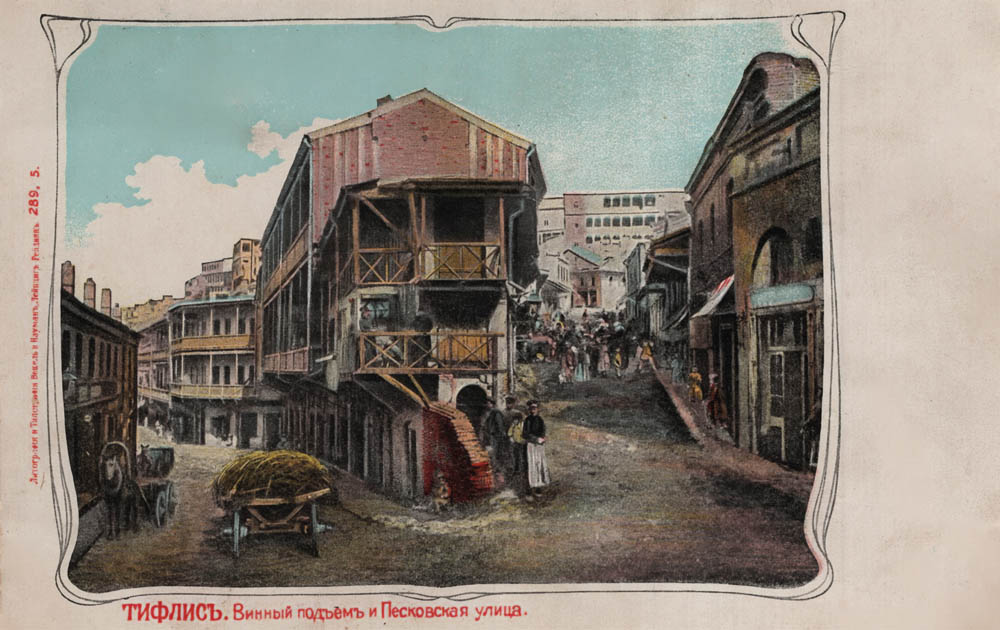
Peskovskaya street ran upward from Avlabari Square along the Tsitsianov Rock (a cliff named in honor of Prince Tsitsianov, who died in Baku in 1806) andt was part of the system of ascents leading up to Avlabari.
The street officially received its name in 1896, referring to the sand deposits from the Kura river or the sandy soil of the slope.
In the XIX century this area housed one of Tiflis’s main wine markets, complete with cellars, dukhans (wine cellar-taverns), and wine shops.
The architecture —t wo- to three-story houses with carved balconies, inner courtyards and painted entryways was typical of Tiflis construction in the late XIX and early XX centuries.
One of the most notable buildings was A. Salzman’s Tavern, which became one of the city’s most popular spots by the end of the century.
It was a German tavern and small inn where both locals and travelers would gather.
Salzman’s wife became famous throughout the city for her scrambled eggs; contemporary press and memoirs noted that she prepared “the best scrambled eggs in Tiflis.”
This grew into a local legend: the hostess, a mother of many children, would personally come out to greet guests wearing her signature white apron.