
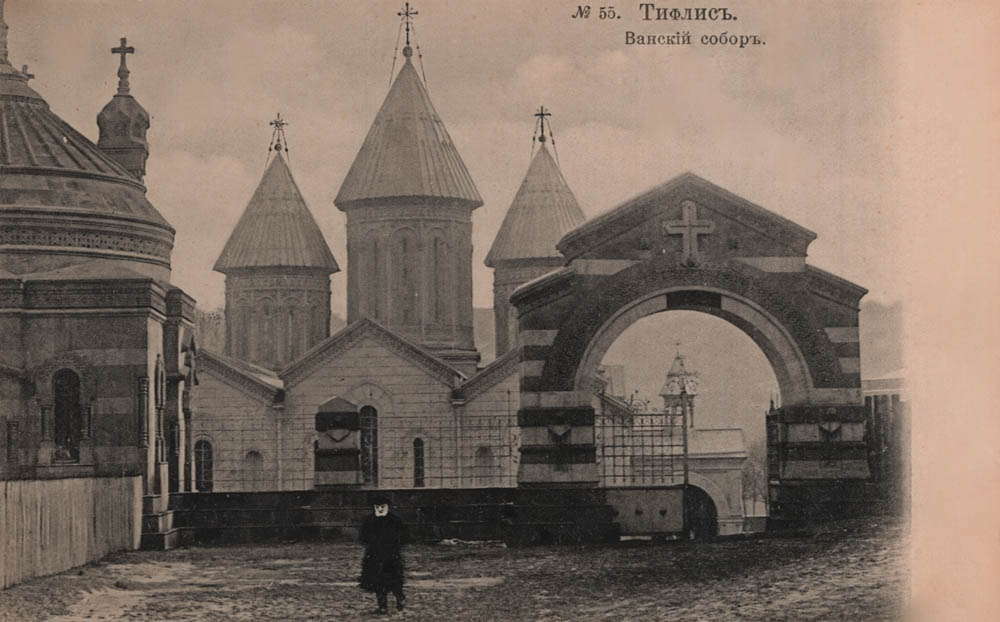
The Vank Cathedral was the main church of the Armenian community of Tiflis and one of the most significant religious structures in the city until the XX century.
It was located in the center of the old town—where Atoneli street runs today in Tbilisi.
The word “vank” in Armenian means “monastery.”
Today, School No. 104 stands on the site of the church, and part of the bell tower has survived nearby.
It is believed that the church was founded in the XVI century by the Armenian community of Tiflis.
According to one widespread version, a small monastic church already existed here around 1480–1500, which was expanded in the XVI-XVII centuries.
The Vank Cathedral was described by the French traveler Jean Chardin (1643–1714), who visited Tiflis in 1672. According to a legend he recorded, the construction of the cathedral was attributed to a certain Turkish pasha who had fled his homeland and converted to Christianity.
By the XVIII century, this church had become the largest Armenian church in Tiflis.
It had a rectangular shape and three naves.
The church bell tower stood next to the cathedral.
Inside the church there were three altars, and the walls were decorated with frescoes depicting the Virgin Mary, the Apostles, and Saint Gregory the Illuminator.
Prominent figures of Armenian, Georgian and Russian history were buried near the cathedral: Count Mikhail Loris-Melikov (1824–1888), Archbishop Gabriel Ayvazovskiy (1812–1880), Alexander Mantashev (1842–1911), the brother of the painter Ivan Konstantinovich Aivazovskiy, the oil industrialist and philanthropist, many others.
Unfortunately, the church was demolished in 1930.