
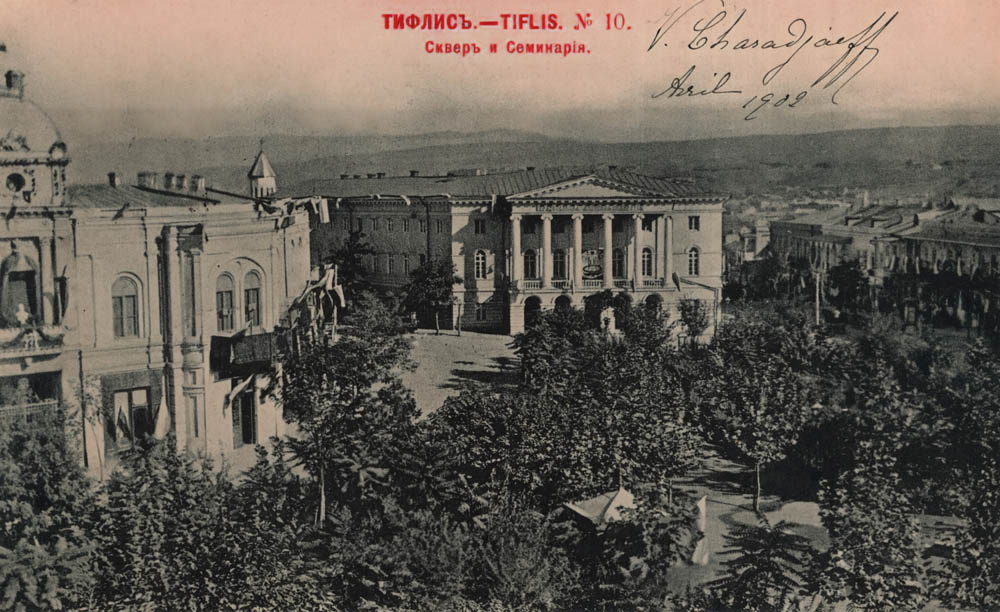
The Tiflis Theological Seminary was founded in 1817, though its permanent building was only completed in 1838.
It was located on what was then Pushkin street, in the area of modern-day Liberty Square.
The project was designed by the brothers Giovanni Bernardazzi (1782–1842) and Giuseppe Bernardazzi (1788–1840).
The seminary was sometimes referred to as the “Zubalov House” in honor of its owner.
In 1872, at the initiative of Grand Duke Mikhail Nikolayevich (1832–1909), instruction in the Georgian language was banned in all seminaries, making Russian the sole language of education.
The lives of the seminarians were conducted under strict supervision: they were forbidden from leaving the seminary without permission, participating in public celebrations, visiting theatres, organising assemblies, or reading “unreliable” literature.
Students were kept under constant surveillance, and regular searches of living quarters and personal belongings were conducted to look for banned books.
Violations of the internal regulations were punished severely: minor offences resulted in a reprimand, while more serious ones could lead to confinement in a punishment cell for several days or expulsion from the seminary, with or without the possibility of re-enrolment.
Among the graduates of the Tiflis Theological Seminary were future USSR statesmen: Joseph Dzhugashvili (enrolled on September 2, 1894, and expelled in 1899 during his final year) and Anastas Mikoyan (enrolled in 1906).
The seminary provided not only a religious education but also a broad humanitarian curriculum: rhetoric, history, literature, mathematics, and foreign languages—French and German—were all taught here.
In 1912, the seminary moved to a new building on Tskhneti Street (now Chavchavadze Avenue), and the old building was converted into the “Tsarskiye Nomera” (Tsar’s Rooms) hotel.
Following the 1917 Revolution, the seminary was closed and the building was requisitioned.
Since 1950, the old seminary building on Pushkin Street has housed the Art Museum of Georgia.