
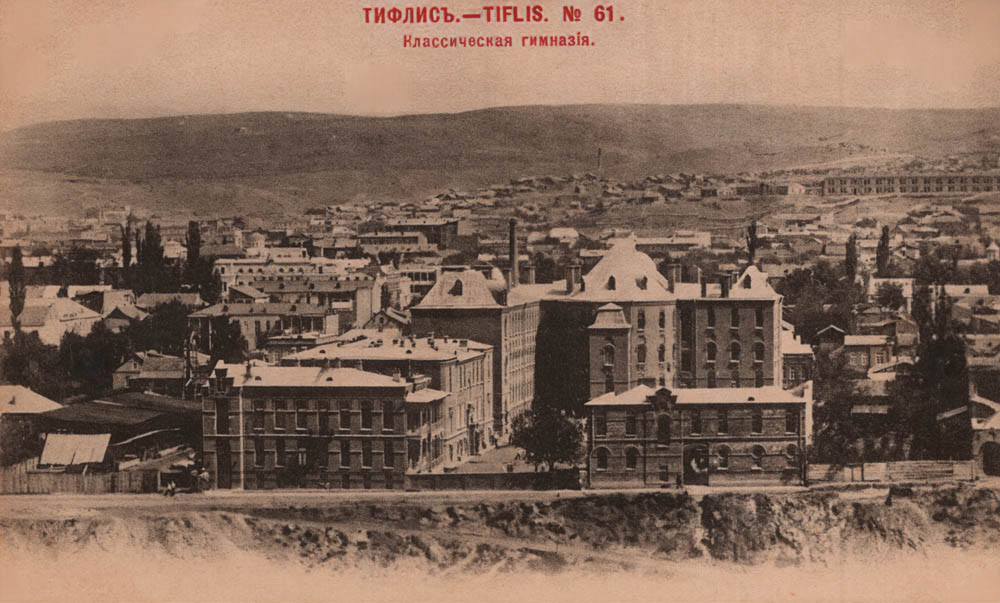
The Classical Gymnasium in Tiflis was one of the most famous educational institutions in the Caucasus during the XIX and early XXth centuries.
The history of this establishment began in 1802 – it was then that a two-grade school for boys was created.
It was located within the office of the Caucasian Commander-in-Chief, the teachers were Russian civil servants, and instruction was conducted in the Russian language.
The school proved unpopular among the local nobility and soon closed.
In 1804, on the initiative of the Caucasian Viceroy Pavel Tsitsianov (1754–1806), the school was restored under the name “Noble School.”
It was located in the center of old Tiflis, near the administrative buildings of the viceroyalty and military institutions.
In 1830, the school was transformed into the First Tiflis Male Gymnasium.
The curriculum was expanded to 7–8 years of study and prepared students for further education.
At the new gymnasium, the subjects taught included Classical languages (Ancient Greek and Latin), Russian and foreign literature as well as History and philosophy. Exact sciences such as algebra, geometry, and physics were also taught here.
By that time, the Tiflis Male Gymnasium possessed one of the best libraries in the Caucasus, and the teachers were often graduates of Moscow, St. Petersburg, or Kazan universities.
Despite this, the gymnasium still did not have its own dedicated building.
Construction of a specialized building for the gymnasium finally began at the end of 1837.
The project was designed by architect Aleksandr Melnikov (1784–1854).
The building was completed in 1839 and was situated on what is now Rustaveli Avenue.
In the 1860s, the building was reconstructed according to a design by architect Otto Isaakovich Simonson (1829–1914).
Following the reconstruction, a well-tended courtyard and garden were added.
It is this specific building that is depicted on the presented postcard.