
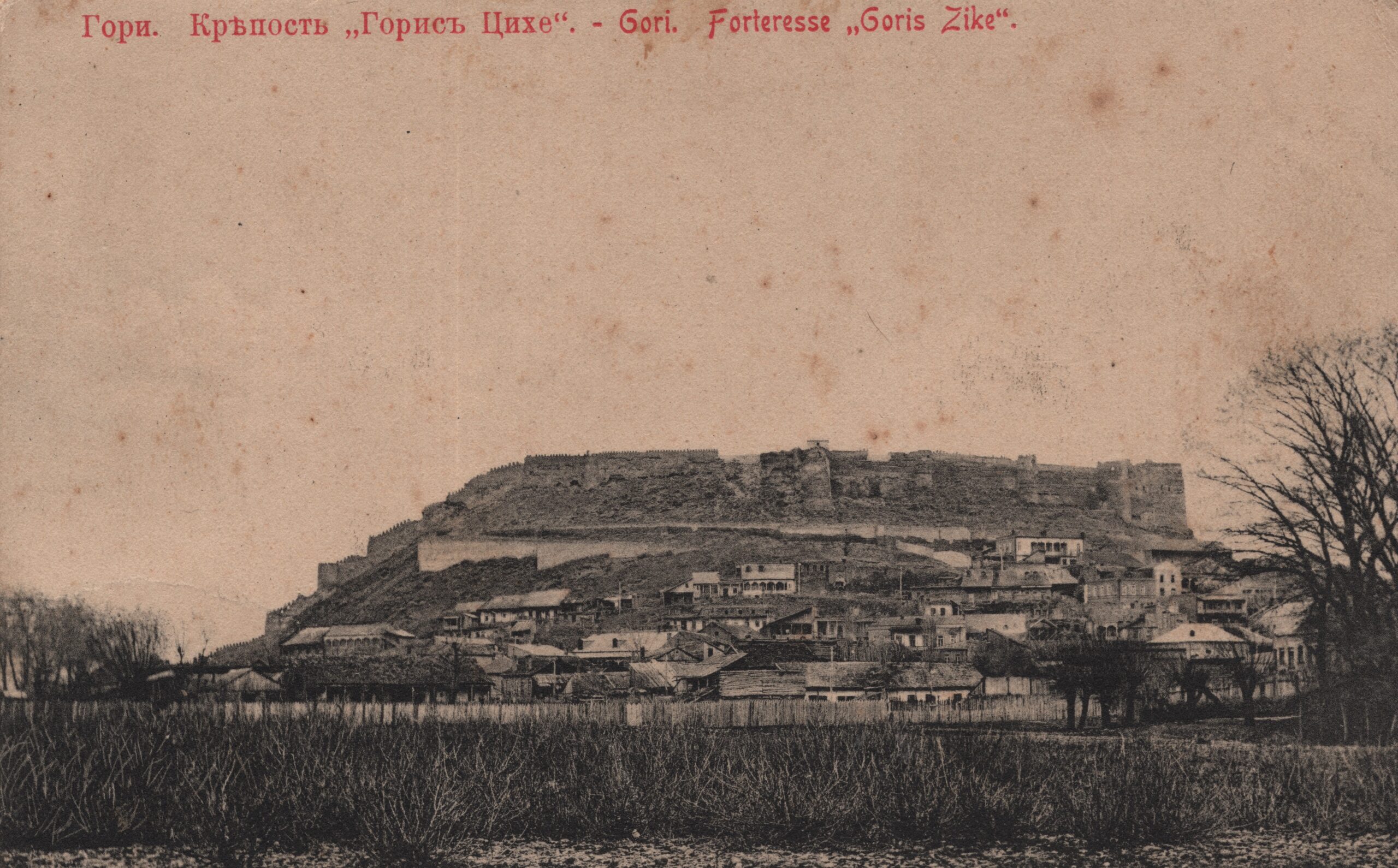
Archaeological excavations in the area of Goris Tsikhe Fortress confirm the existence of a fortified settlement as early as the V-IV centuries BCE.
The first written reference to the fortress itself dates to the late XIII century: according to several historical sources, it was captured by the Alans under the leadership of King Os-Bagatar II (d. 1306) and remained in their possession for approximately twenty years.
In the XVI century, Goris Tsikhe came under Ottoman control.
In 1598, Georgian forces led by King Simon I the Great (1537–1603) undertook a three-month siege, which ended unsuccessfully.
A renewed attempt in 1599 proved successful owing to a military stratagem: during Lent, the besiegers feigned a weakening of the siege and then launched a sudden, decisive assault.
According to the Persian court historian Iskandar Munshi (1560–1634), the fortress was restored in 1614 by order of Shah Abbas I the Great.
It is likely that soon thereafter Goris Tsikhe once again came under Georgian control, as Vakhushti Bagrationi (1696–1758) records that in 1634, upon the arrival of King Rostom (1565–1658) in Tbilisi from Safavid Iran, the fortress was rebuilt and an Iranian garrison was stationed there.
Goris Tsikhe acquired its final medieval appearance in 1774, when it was substantially reinforced by King Erekle II (1729–1798).
In 1801, the fortress was occupied by a Russian grenadier battalion, but its strategic importance gradually declined and the fortifications fell into disrepair.
A city plan of 1824 depicts the citadel, the urban quarters on the surrounding hillsides, and a moat encircling both the fortress and the town.
The British Encyclopædia Metropolitana reported in 1845:
“At the foot of a chain of low sandstone hills stands the Town and Fortress of Gori, (perhaps the Gursenna of Strabo,) the next place in magnitude and importance to Tiflis.
The Castle, an oblong, 200 paces in length, placed sixteen fathoms above the level of the Liakhvi, running at the foot of the hill on which it stands, is now abandoned, a Chapel in its South-Eastern edge being the only part in use.