
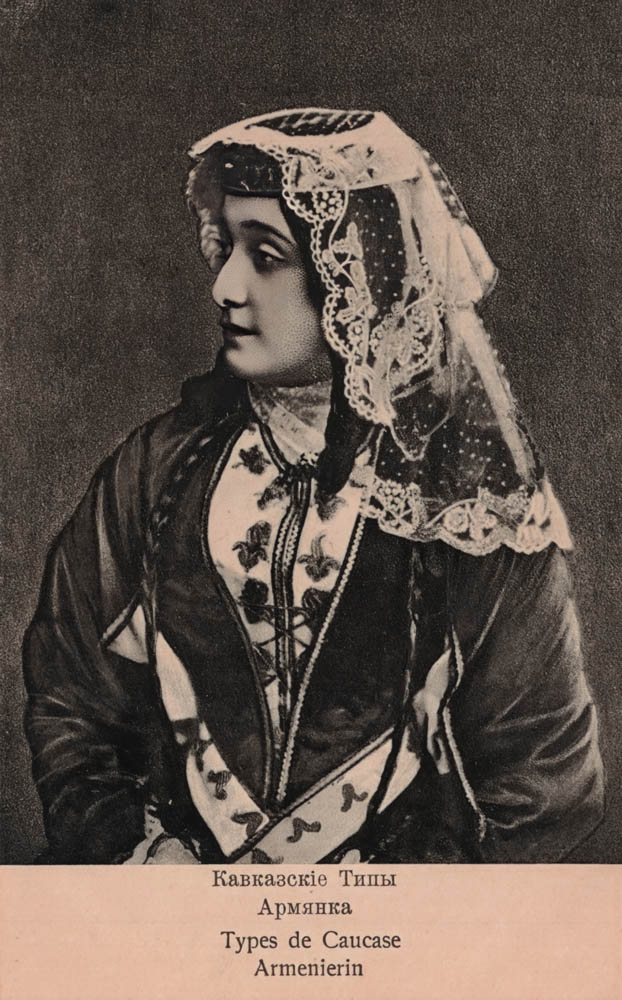
The Armenian national costume is called taraz.
The word itself, when translated from Armenian, means “appearance,” “look,” “form,” or “style.”
Women’s taraz was striking for its particular elegance, multilayered structure, and richness of decoration.
Its basis consisted of a long undergarment shirt called khalav and wide trousers pokhan (or shalvar), which were usually tied at the ankles and often decorated with embroidery.
Over these was worn the dress arkhaluk—graceful, often fitted at the waist, with side slits.
It was made from high-quality fabrics such as satin, silk, velvet, and sometimes brocade.
For special occasions and holidays, another dress—the mintana (often without side slits and more ornate and ceremonial)—was worn over the arkhaluk.
For a married woman, the most expressive part of the ensemble was undoubtedly the headdress.
In the Eastern Armenian tradition it was tall and complex in construction.
Its base was a red felt cap (sometimes made of very fine felt or fabric), 8 to 20 cm high, often shaped like a slightly slanted cylinder or a small “tower.”
Placed on top was a dense woven circular band of velvet or silk about 7 cm wide called vard (which translates as “rose”).
Attached to the front of the vard were double (and sometimes multiple) rows of gold or silver coins and other ornaments—pendants, chains, and so on.
When going outdoors, a large semi-transparent covering (veil) was draped over everything, reaching from the crown of the head to the heels.
Its edges were richly trimmed with lace or fine embroidery.
The color depended on age: younger women more often wore white or light-colored veils, while older women wore blue or dark ones.