
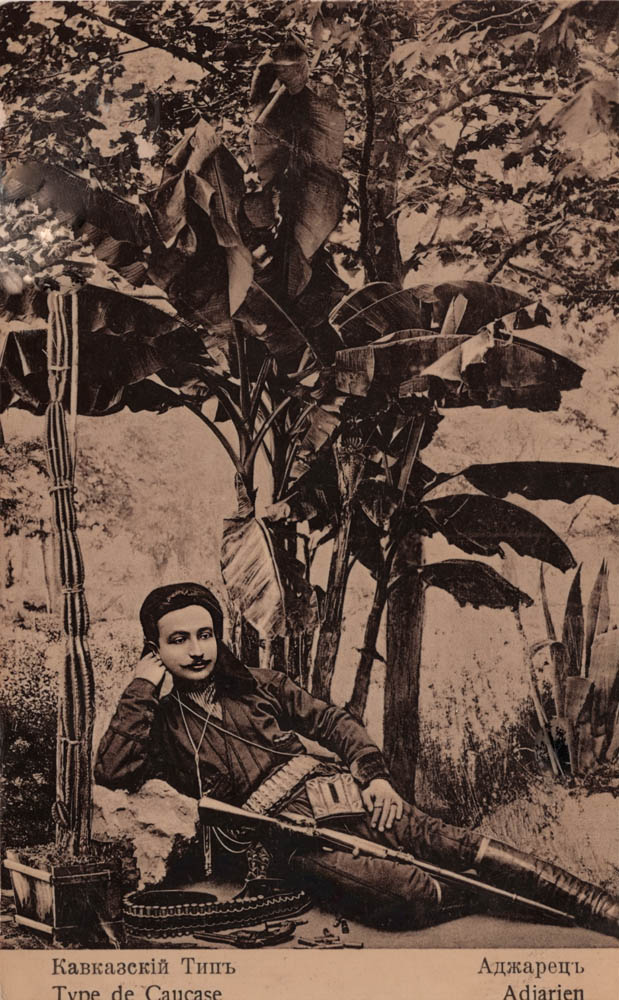
The Adjarians are an ethnographic group of Georgians and the indigenous population of Adjara, an autonomous region in southwestern Georgia with its administrative center in Batumi.
The Adjarian dialect of the Georgian language is considered one of the most archaic and lexically rich.
It has preserved a substantial number of words and grammatical forms from old Georgian, as well as a noticeable layer of Turkish loanwords, which gives the speech a distinctive and unmistakable sound.
The uniqueness of Adjara is especially evident in the religious sphere.
Although the majority of Adjarians adhere to Sunni Islam, local religious practice is closely intertwined with traditional Georgian customs.
Memorial rites on the 3rd, 7th, and 40th days after death are still observed, while major Muslim holidays (including Ramadan) are often followed partially, selectively, or combined with local traditions.
The distinctiveness of the Adjarians is also reflected in religious architecture, most notably in the famous wooden mosques of Upper Adjara (the mountainous municipalities of Khulo, Shuakhevi, Keda, and partly Kobuleti).
Built mainly in the XIX and early XX centuries, these structures represent a unique phenomenon in Caucasian Islamic architecture.
From the outside, the mosques are often modest and resemble ordinary mountain houses—simple wooden log buildings without domes (or with very small ones) and with understated minarets, often added later and made of wood or metal.
In contrast, the interiors are striking for their richness and density of decoration.
The walls, ceiling, mihrab (the niche indicating the direction of Mecca), and minbar (the pulpit for sermons) are covered with vivid polychrome painting and exquisitely fine wood carving.
Among the most common decorative motifs are grapevines with clusters, pomegranates, lemon trees, and other fruit-bearing plants.