
Caucasian soldiers most often served in irregular units, militias, and convoys.
During the years of war, so-called “mountain militia” or “hunters” were formed from them — detachments organised along ethnic or regional lines: Ossetian, Avar, Dagestani.
These units were employed for reconnaissance, guarding communications, and diversionary actions to draw off enemy forces.
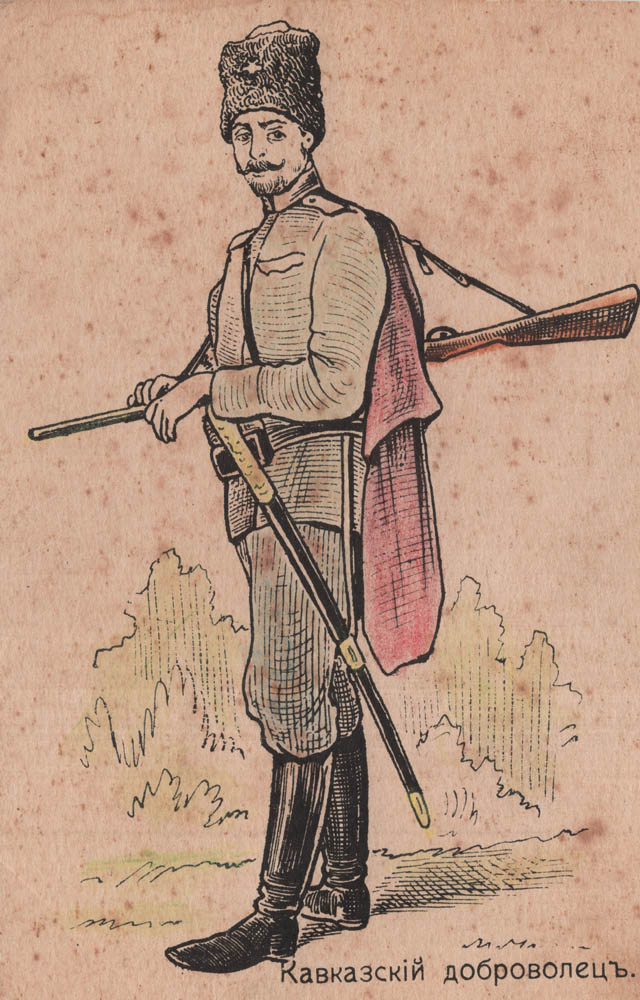
Postcard shows the classic appearance of a Caucasian warrior — a type that remained virtually unchanged for decades and ultimately had a noticeable influence even on the formation of the Cossack military uniform.
The volunteer is dressed in a cherkeska — a long collarless caftan girded with a narrow belt.
The pockets on the chest are called gazyrs: originally intended to hold pre-measured charges of powder, over time they largely became a decorative element of the uniform.
The warrior’s tall headgear is a papakha. It is an integral part of the traditional costume of many Caucasian peoples — Circassians, Dagestanis.
In the mid-XIX century, the papakha was also adopted in the regular army, although some units had used it as early as 1817.